
Nigerians have become used to the defections of politicians who move from one party to the other. The movement occurs from the opposition party to the ruling party or from the ruling party to the opposition or starting a new party.
The movement is often based on self-interest clothed in the garb of patriotism, rather than political ideology or for peoples’ interest.
The defectors do not do so based on fundamental ideological disagreement or interest in pursuit of the growth and development of Nigeria but they do so based on which platform offers the defector a cover for his ambition and political interests.
In Nigeria, political parties serve as a medium for the politicians to reach their political desires. No political party in Nigeria has any ideology. One cannot say that party A stands for this and party B stands for that, so that one aligns with a party that represents one’s beliefs. It only serves as a platform for actualising self-interests.
The lack of ideology is evident in the proliferation of political parties, as some of them have not won a single election, have no identifiable office or have conducted any convention. It is also evident in the policies enacted in the country, where political parties have no policy direction. Each politician has an agenda and even has the party leadership in their pockets. As such, party supremacy seems to exist only on paper.
Party defections got its root from the cross-carpeting of some members of the then Western House of Assembly in 1951 who defected from the National Council of Nigeria and Cameroons (NCNC) to the Action Group (AG) to enable Chief Obafemi Awolowo become the Premier of the Western Region instead of Dr. Nnamdi Azikiwe of NCNC.
One would ask what the defections have benefited Nigeria and Nigerians? The answer is more in the negative. If defections are positive, Nigerians would benefit more through developments and national cohesion.
Read Also:
The Constitution provides that elections are championed and won by the political parties and not individuals. This makes it absurd that the party’s elected person wakes up and defects to another party carrying with him the votes and mandates given to the party by the people. As Nigerians don’t seem to have a solution to it, they have become used to it and have accepted the defections as normal politicking.
In 2019, the National Chairman of the All Progressives Congress (APC), Adams Oshiomhole, urged members of the opposition party to join the APC so that their sins could be forgiven. Politicians who had skeletons were defecting, some of the politicians defected to be in the good books of the president and for patronage. In 2014, many elected officials defected from People’s Democratic Party (PDP) to APC which boosted the chances of APC to win. Each of the parties want defectors to boost their image and to win elections.
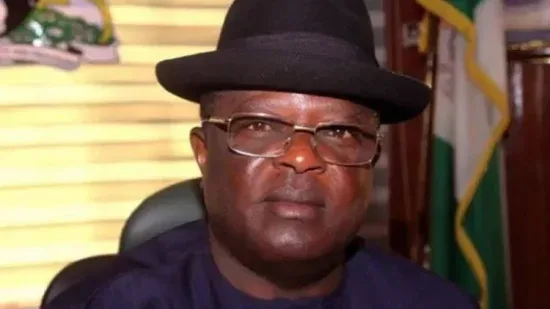
In the case of Governor David Umahi and others, who are not the first to defect, they are asked to vacate their seats by the court for defecting.
Justice Inyang Ekwo in his ruling averred that “Votes won or scored by a political party at an election is retained by the political party irrespective of the death or exit of the candidate it sponsored for the election, from the political party.”
He said, “A declaration that candidate of a political party that won the majority votes at an election is not entitled to retain or continue to lay claims to the votes won by the political party after moving to another political party, rather, the candidate is bound to inherit, utilize or appropriate the votes won by the new political party he has adopted”.
“There is no constitutional provision that made the ballot transferable from one party to the other,” Justice Inyang added.
The constitution in section 221 states that, “No association, other than a political party, shall canvass for votes for any candidate at any election or contribute to the funds of any political party or to the election expenses of any candidate at an election.”
In reality, a political party in Nigeria is not voted for, rather it is the candidate of the party and this has made it possible for the politicians to defect to another party after the election.
If the court found defection wrong, many governors and other elected officials that have defected over the years would have vacated their seats and the receiving political parties would have rejected the entry of the politicians but what is happening to Umahi is connected to his 2023 presidential interest.
PDP would be happy to take back the seats, would APC be happy to relinquish their seats?
Governor Umahi, since he defected to APC which President Buhari described as “a bold move” has been working hard to be seen as a very loyal party man; always present and vocal in praise of the president and his party. But, he is also conducting rapid infrastructural development in Ebonyi state.
Political defections have not helped in building a strong party system in Nigeria or national cohesion but have caused more divisions. If Umahi should be punished for defecting, let all defectors be punished.