
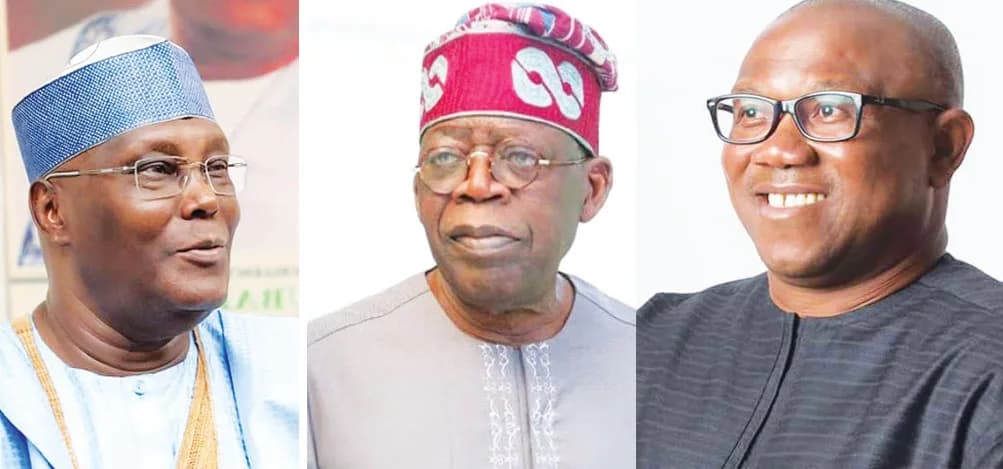
For millions of Nigerians, the 2027 election may be influenced by the usual ethno-religious considerations but it will ultimately come down to one reality; the economy. Presently, food inflation, currency collapse, insecurity and the economy are on life support. The price of goods in the market is not determined by ethnicity or religion.
In this 2027 election, slogans and political machinery will not reduce the inflation or bring food to many tables or end the insecurity daily, claiming lots of lives. As Obi, Tinubu, and Atiku lined up for a rematch after 2023, the question on the lips of most Nigerians should be who actually has the practical path out of this economic crisis.
Following the 2023 election, the top on the list of what troubled Nigerians was the state of the economy as former President Muhammadu Buhari left Nigeria as the world’s headquarters of poverty where 133 million Nigerians were in a multidimensional poverty. That number has increased.
In as much as the candidates had talked about the economy based on subsidy removal, currency volatility, only Peter Obi was able to package his idea in a catchy slogan: from consumption to production.
It is not about the slogan but the state of the economy if it will be improved or continue to totter following the outcome of the next election.
These three heavy weights candidates; Peter Obi, Bola Tinubu and Atiku Abubakar contested to lead Nigeria in the previous election. They had a fierce head to head contest as Bola Ahmed Tinubu became announced as the winner even with many identified malpractices including the BBC reported switching of votes from Peter Obi to him in Rivers state and secured a judicial affirmation even though he became the president with a minority of the total vote.
For the 2027 election the three contenders have presented themselves again. This time, Tinubu does not seem to want to return to the office with a minority vote. He has made sure he placed his allies in the Independent National Electoral Commission, INEC and brought over many governors who switched to his party, and others, working for him from their respective parties. His desired mantra was to fight, grab and run with the votes. He requires his supporters to ‘stand on his mandate.’
Tinubu may be playing politics, working to consolidate using governors, INEC and party machinery, but political control cannot fix an empty treasury, pay off his increasing loans or put food on the tables of many Nigerians or fight insecurity.
The outcome of that 2023 election would be placed as a consequence of the current state of the economy.
Read Also: Nigeria: A Nation Sovereign in Name Only
It is another election period and president Bola Tinubu does not seem to have any economic agenda, his policies have plunged the country into unprecedented national debt and high inflation and increased poverty across the social class following his ill considered announcement of the removal of subsidy on fuel. This has once again situated the country’s state of the economy at the centre of the 2027 election.
According to the National Bureau of Statistics, the inflation rate dropped 14.63% from 15.39% in September 2026. It may be celebratory to the Tinubu administration, but the purchasing power of Nigerians is still low and affordability is far-fetched. Even if inflation numbers slow down on paper, the price of a bag of rice or a tuber of yam still costs more. Household expenses have become more than most families earn in a month.
Given the overall poverty rate across the country, we have to look at the policy proposals of what these candidates, if they get power, will do to ease the pain of the economy.
President Tinubu’s economic agenda brought the country where it is even with his so-called reforms that established taxation laws, but poverty cannot be taxed. You cannot tax people who don't have enough money to eat.
Heading into the election, he stated, "The hard foundation has been laid; now comes the harvest." The harvest is the taxes. It is a preparatory statement of where his focus will be should he get announced again as the president. In addition to this, Tinubu has borrowed so much money that the national debt has increased. For Tinubu's argument, his touted reforms have done nothing to ease the compressed economy at this time, this could be his only ideas to solve the high poverty rate. Which he may have proven that he cannot solve.
Subsidy removal became catastrophic but subsidy on fuel was a cesspool of corruption through the middlemen and a burden on the economy. To solve the economic crunch, Atiku Abubakar has proposed the return of the subsidy which he described to be production subsidy designed to lower energy costs while accelerating domestic refining. So instead of subsidising fuel importation, Atiku would be subsidising fuel production and refining. But a critical case of interest is how to checkmate the corruption. Is it a transfer of corruption from the previous middlemen to a new class of refiners while the people continue to bear the continued cost.
Obi saw the economic intervention differently. As much as his economic policy centres on from consumption to production, he wants to bring manufacturing to Nigeria which will employ many people, leverage the distinct economic strengths of each geopolitical zone and invest in infrastructure and electricity. As much as this sounds incredible for the future, manufacturing is a long term investment but there must be an alleviation of the economy to immediately offset the current pain.
Come 2027, political machinery, party switches, and ethno-religious appeals may secure the votes or shift the interest in a divided Nigeria but these cannot rewrite or improve the current economic reality. Among these three candidates, whoever between Obi and Atiku takes the helm will inherit an exhausted treasury, soaring national debt, and a population pushed to the brink midwifed by Tinubu. If Tinubu returns to power, it is a rollercoaster continuity of what brought the Nigerian economy to the level it is.
The real question is not whose policy model becomes more attractive on paper and in campaign, it is whose model can become practical, and implementable with a sincerity of purpose to lessen the burden on many homes; presently and into the future.