
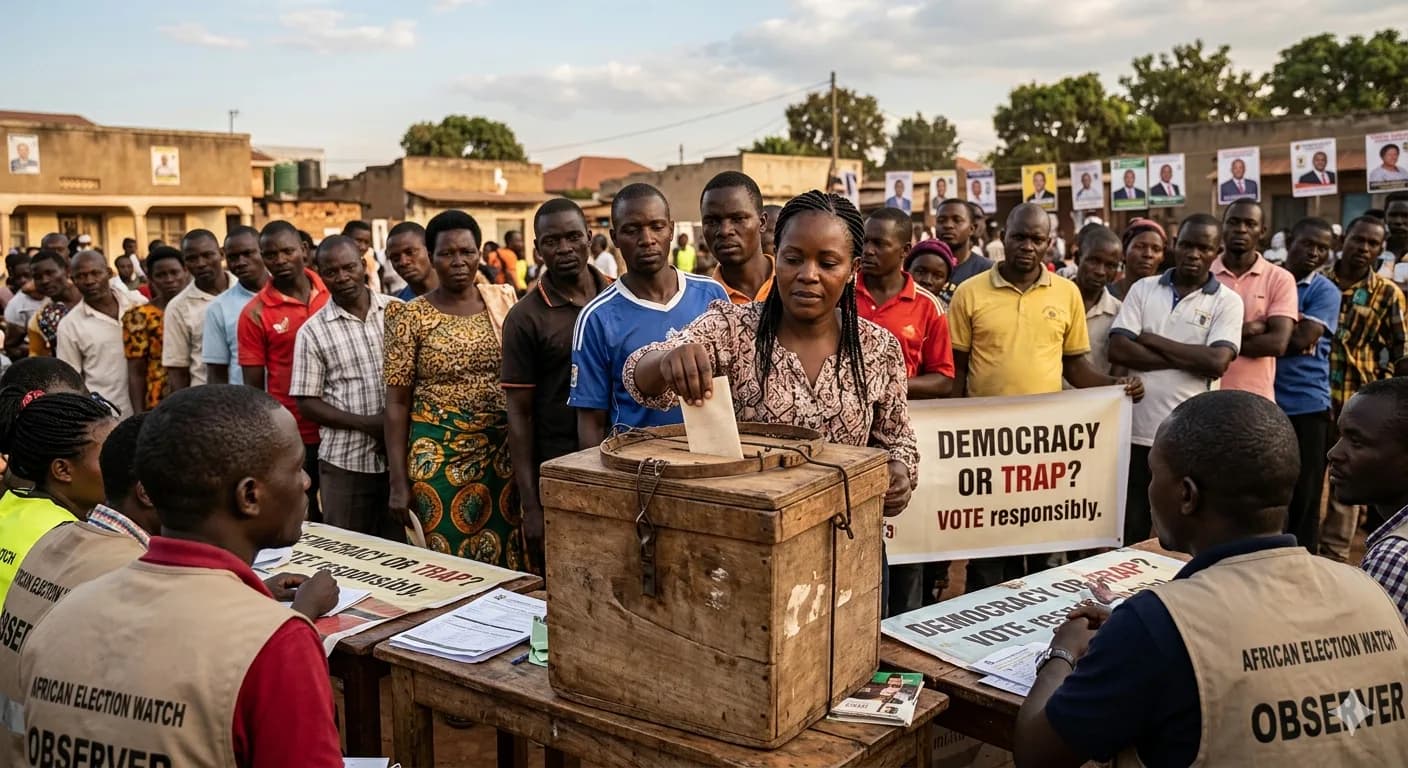
Every few years, millions of Africans stand in lines under the heat, the rain, and the discomfort - all for a single promise: that voting will finally change the course of our lives. But as the voting begins, chaos like ballot box snatching erupts. When the voting ends, the story of result manipulation including judiciary corruption stays the same. We’re made to believe and accept that the ballot box is the ultimate tool for democratic liberation. But what if, for Africa, the ballot box has become a trap?
Many people believe Africa has a problem of leadership. While it may seem a problem of leadership, I dare say that the problem of Africa is in the choosing of leadership and that takes us to the ballot box.
The process by which African leaders emerge is a fundamental problem. When you combine this flawed process with the sit-tight mindsets in Togo, Cameroon, or Uganda, you get a system engineered to fail. This failure is systemic. We see it when leaders push for one-party dominance in a multi-party system. We see it in judiciary collusion. And we see it when constitutions are rewritten just to extend terms, like in Rwanda. We often refer to these as playing politics, but they have always been the elements of ballot traps.
Today, we are not just going to talk about election loss or win. We’re asking a deeper and uncomfortable question: Why does voting fail to produce the leadership Africa actually needs? Is democracy in Africa a solution, or is it a system designed to keep Africa running in circles? Is voting an involuntary act to validate that system which works against us?
At the end of colonisation across Africa, while nations on constructed borders were ready for independence, Britain’s Colonial Office utilised elections as a way to maintain British influence in Anglophone countries and stabilize the transfer of power. In the document, “"Democracy in backward countries: Implications for the Future", it states that “Westminster democracy cannot be expected to work well in countries with low standards of living and education…Since international expectation and African nationalists demanded elections before independence, they must be held”. This justified the introduction and implementation of a secret ballot system. In francophone countries, the Two-Round System of voting was introduced. While elections were adopted by the colonial administrations to discipline the African nationalists and use it to choose their preferred candidates, the nationalists saw elections as a way to legitimise their leadership. The people, in turn, saw it as the power to choose those who would secure their benefits. Ultimately, elections became a tool.
Read Also: Museveni’s frail presidency
The ballot box trap is the illusion that through voting, the people freely choose their visionary leaders but in reality, it became a structural filter designed against visionary leaders, exhaust the citizens, and legitimise the corrupt people.
Before the colonial construct, many African nations had traditional set-up on how to choose their leaders which all respected and things got done. These western style elections introduced adversarial methods that pit people against each other - which often results in bitter engagement or do-or-die approach, has now pivoted to being transactional. The money that is supposed to be utilised to build infrastructure, economy and healthcare centres are deployed for the ballot. Election has become a business where politicians and investors invest in an election with the mind to reap with interest against what will benefit the country and the people.
From Nigeria to Zimbabwe to Sierra Leone to Tanzania and across Africa, the story is basically similar.
Politics is trapped in a cycle of tribal and religious loyalty where primordial sentiments are often invoked. Africa’s societies are also paternalistic in that some people think that only they know what is good for the people and voting is often determined by kinship regardless of policy or vision. This has served as a preservation trap where even though the individuals are not performing well, they receive fraternal support.
Elections have become a gathering of the compromised, legitimised by the ballot trap where the cost of representation becomes so high as a filter against the visionary leaders who may not be able to afford the office, leaving the room for the inadequate authoritarians often controlled by external influences buying their way through the political party and office with limited foresight or visionary policies. What if the people through the law are allowed to participate in choosing the candidates and also funding them?
In Nigeria for example, the party chooses the candidates through the delegates. The people then queue behind whomever the party chooses in the general election. This gives ultimate power to the delegates who are the base for which many political calculations reside, including bribing. Whoever the delegates choose, the party endorses and the people queue behind. This choosing process is a trap where the people have limited ways to choose for themselves who leads them based on the visions presented by the candidates.
Across Africa, the demand is basically the same. Strong visionary leaders, safe streets, access to opportunities, health care, robust economy and great infrastructure. tackling corruption, and providing essential services like electricity, education, housing, food, clean water, good roads and internet access. These essential services are not dividends of democracy; they are basic human rights that have been turned to weapons upon which the cycle of leaders make their promises and weaponise for the next election cycle. The endemic systemic poverty has become a ballot trap, weaponised for voters to be given some inducements - called stomach infrastructure - in Nigeria. These inducements are engineered for ballot harvests. Poverty makes people vulnerable, but ethnic manipulation also keeps them divided. Politicians invoke these identity politics so that voters fight each other instead of uniting against the ruling class that creates and utilises poverty for entrenchment.
Many voters, during elections, are bombarded with information that is often more propaganda designed to lull the voter into believing that there is a difference when the candidates are simply two sides of the same coin. The ruling class posture to be the voice of the masses. Incidentally, there are people in that class of society that are more sincerely interested in building a legacy for the people than those seeking election for self-aggrandisement and the enjoyment of the appurtenances of government
We see the blatant manipulation of institutional structures, control of electoral commissions, deployment of state resources for campaigns, and the leveraging of media dominance. Then comes the digital trap of internet control and manipulations where surveillance, blackout and digital malfunctions are deployed and choreograph election victories from the collation centers after ballot box stuffing, destruction of legitimate votes and voter intimidation.
Ballot trap does not end when the results get announced. It has become an era where the courtroom which is supposed to adjudicate based on constitutional requirements has become a second ballot box. It has become a clearinghouse where law is bent to validate the bought and manipulated votes for the approved winner, often disguised as technicality rather than to protect the voter. The judiciary has become the ultimate legitimacy ballot trap.
We must not forget the international angle who partner with candidates that uphold their interest, sanitise the rigged elections by sending high-level diplomatic endorsements and election monitoring team, validation of the rigged elections by promptly congratulating the announced winner, offering international legitimacy, promptly advocating to restore order with military and financial aid trapping citizens with democratically elected authoritarians with no idea of how to develop their countries and Africa.
These have caused low voter enthusiasm and loss of hope especially among the youths.
For Africa to get the leadership she deserves, the ballot box trap must change.
First, since the adversarial process of choosing leaders has been adopted, the people must be allowed to choose the candidate right from the primary selection up to the final election. This will eliminate the illusion of choice, while voters have back their power of choosing and electing a candidate and also to send them packing when they do not perform.
Having to face the voters becomes an important task only visionaries will face because that involves laying bare the visions and policies rather than the paternalistics ideas.
When voters play very active roles in the selection process, they will no longer be trapped to a large extent with stomach infrastructure, international overbearing control and can no longer be weapons for continued systemic poverty, subjugation, and exploitation.
Independent candidacy should be encouraged and supported by crowd-funding to by-pass structures put in place to screen out worthy individuals as a way to break the hegemony of entrenched party politics, even if those independent candidates face uphill battles regarding nationwide reach.
Leadership is a problem but the system that throws them up needs fundamental reform. And given that it almost seems undoable, but having the knowledge of the ballot traps is a starting point to having the fundamental solution earnestly needed for Africa to be great.