No products in the cart.
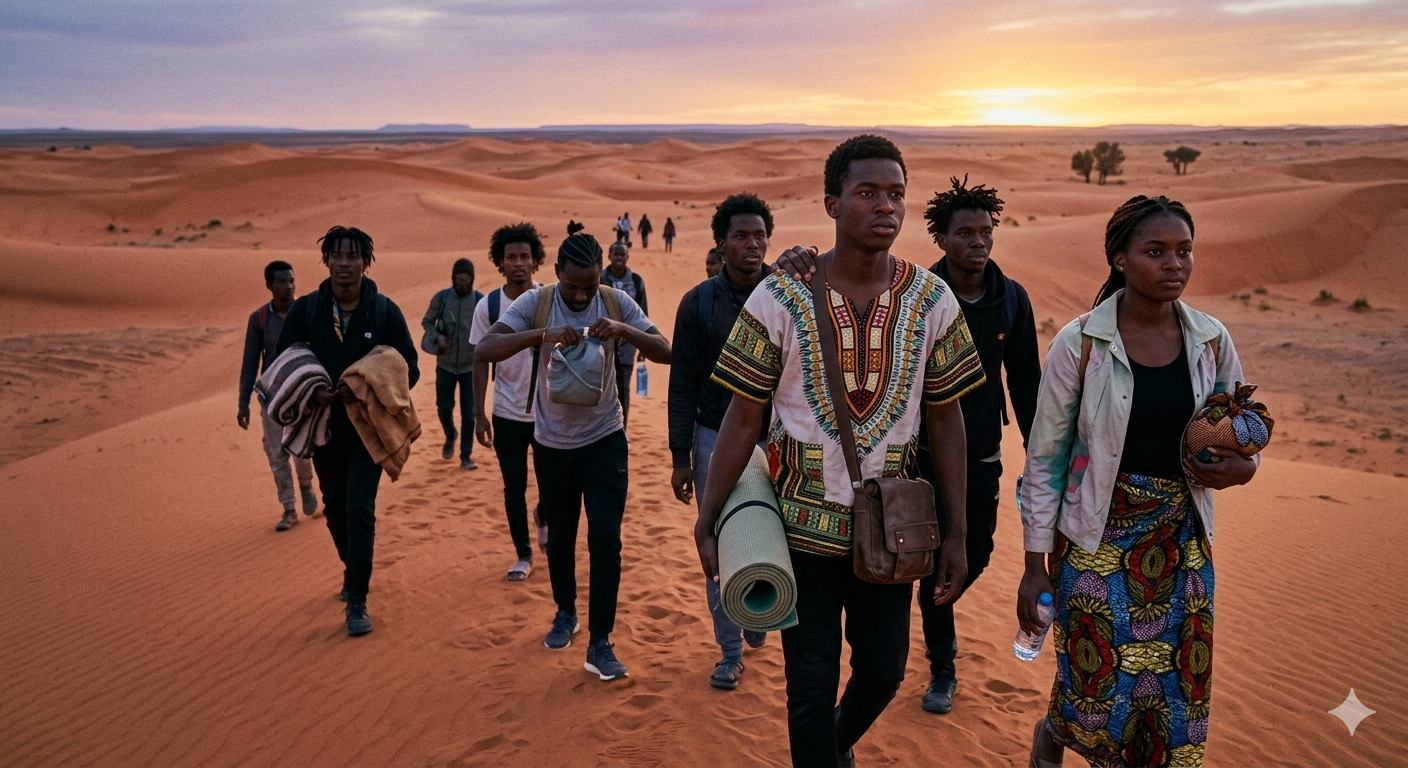
Migration is a big story coming out of Africa in recent years. Many African youths hunger to leave the continent in search of better opportunities.
Human migration or movement is constant, I can acknowledge and Africa has never been immune from migration. In fact, historically, Africans are associated with migration in search of their wellbeing. But while at that, is migration helping Africa?
You may wonder what African leaders are doing to stop this and why has it become somewhat rampant that many African youths see success only if they can leave the shores of Africa. Beyond that, Africans were subjected to forced migration in form of slavery and slave trade. When slavery was abolished, the hunger was how to return the freed Africans back to Africa.
A century ago, what dominated the black movement known as Back to Africa was the repatriation of the blacks.
After the abolitionist movement of the 18th and 19th century, there was a call for the blacks to return to Africa.
It was to return them to where they were shipped from many decades before. Part of the problem was that over four centuries of slave trade and slavery, many of the offsprings could not trace the ancestry or their ancestral lands.
It was Paul Cuffee who first started the Back to Africa movement in 1815.
Sierra Leone was created in 1787 and Liberia in 1822, as settlements for the freed black people.
Paul Cuffee was a sea captain, born in 1759 to a freed slave who was traced to Ghana. Cuffee wanted the freed blacks to establish a colony in Africa and transported about 38 Africans to Sierra Leone. Yet, the idea was met with opposition which stalled the movement. Although many who were repatriated died due to the conditions of the terrain, the American Colonisation Society further advanced the cause by creating Liberia and repatriating a lot of people to the estimated 12, 000 returnees.
When Cuffee died, even though his dreams were not fully met, the idea and the movement did not die.
A century later, Marcus Garvey would resurrect the back to Africa movement.
Before the wave of political independence across Africa, the would-be leaders who fought for independence were to study abroad. They returned to lead various African nations post independence.
Despite the efforts of these black and African leaders to create a continent of proud people, in the 21st century, the tide has shifted.
Many young and not so young Africans now have a desire to migrate. Of course there are many African migrations within the African continent which the African Union considered crucial for achieving the objectives of the The African Continental Free Trade Area as well as regional integration – we can take a look at how migration, trade and regulation affected the European Union which prompted Brexit. But the focus here is the migration of Africans to Europe or North America and elsewhere.
Many Africans tend to migrate for education, security and economic reasons, poor infrastructure, development, low opportunities and peer pressure. Many young Africans take the risks through the Sahara desert and Mediterranean Sea to arrive in Europe. Many spend millions of what they could utilise to establish themselves in their country. Many die before they reach their supposed destinations.
While it could be a gain for these western countries, touted to be in shortage of labour, it is a drain for African nations.
It is as well for the continued growth and expansion of the global North to the detriment of the global South which Africa belongs to.
Many who believe the leaf is greener on the other side tend to be more from the middle and lower classes who are more devastated by the governance of neglect. Many professionals and manpower leave.
While Africa drains, migration has become a sore topic in these western nations who decry the population increase of migrants often criticised as demographic replacement and being averse to the seemingly few years experiment of multiculturalism which campaign for remigration will be taking centre stage.
Despite these, African nations and leaders who don’t seem to bother at its loss, do not care about the demographic disadvantage with the young population that it is losing.
During the slave trade era, Africa lost about 12 million able bodied men and women.
While there are risks of brain drain and population decline, many African leaders tend to accommodate the migration based on the diaspora remittance of funds.
Agusto & Co had projected the foreign exchange remittance flow into Nigeria would rise to about $26 billion in 2025. Nigeria is only second to Egypt while other African countries benefit too.
Such hope as to depend on diaspora remittances enabled by migration partly to fund the economy of African states, can also be termed as a lazy approach.
African leaders should create conditions that improve life, create jobs, secure life and provide healthcare. With enormous material and human resources, they can eliminate what drives forced migration which, with the youthful population, build an economy that is resilient and stabilise the nations’ sovereignty and retain the brains that will uplift the continent.
The rapid migration does not offer respect to the people of Africa. And as such are not often important in global discussions.
While African leaders during the fight for independence and the Back to Africa movement understood the importance of getting educated, and returned to build Africa, the youths of today treat migration as liberation and the only solution to their problems. But who will build the new 21st century Africa when the generation with the strength only sees solutions in running away?